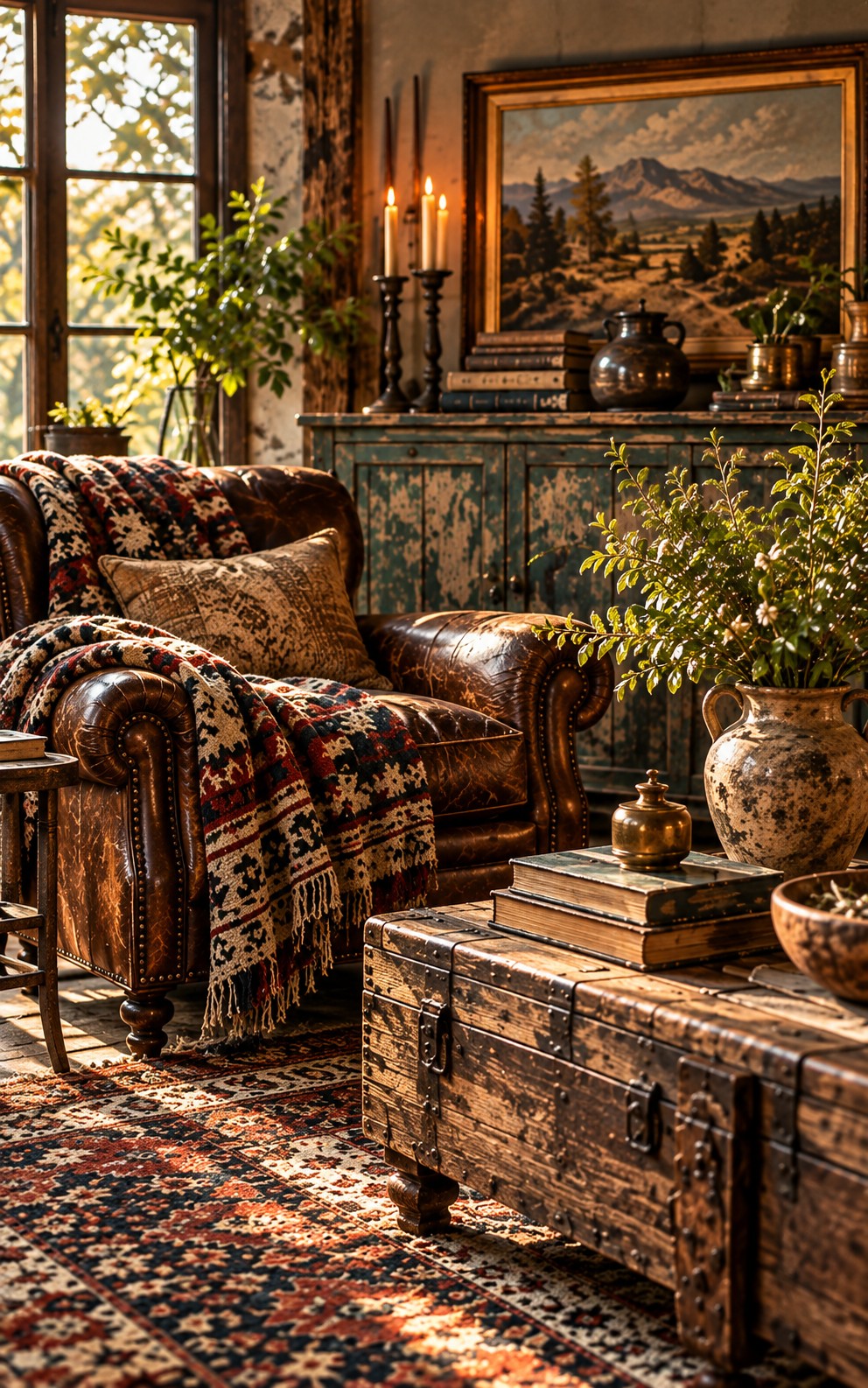
Having spent years as an interior designer, I learned fairly quickly that there is a real difference between a room that has been decorated and one that has been collected over time. You can usually feel it before you can explain exactly what is creating the difference.
Some rooms may be beautifully designed, perfectly coordinated and technically correct, but they still feel a little flat. Others are filled with things from different eras, different places and different parts of someone's life, and somehow the whole space feels deeper, warmer and more interesting.
I have always felt that spaces carry a certain energy, and much of that comes from what we bring into them. Objects that have been handled, inherited, traveled with, repaired, loved or made by hand seem to bring something with them that new, anonymous things often do not.
It might be an old leather chair beside a newer sofa, a painting found years ago hanging over a handmade table, books that have actually been read, a wool blanket thrown casually over the arm of a chair, something inherited from family, or something brought home from a trip because it simply felt impossible to leave behind.
None of those things necessarily “match,” and yet together they can make a room feel incredibly whole.
That is what I think of when I think about a collected room.
What Is a Collected Room?
A collected room is a space that develops gradually, through living rather than simply decorating, and the objects within it are there for different reasons. Some are beautiful, some are useful, some are old, some are handmade, and some may have very little monetary value but an enormous amount of personal meaning.
It isn't really a decorating style, which is part of what makes it so interesting.
A collected home can be traditional, modern, minimal, layered, refined, rustic or some combination of all of those things. You can mix antiques with new furniture, original art with things found at a flea market, or a very simple contemporary piece with something that has been around for a hundred years.
What matters is not whether everything comes from the same place or period, but whether the room feels personal.
That is also why truly collected spaces are so difficult to copy. You can buy the same sofa, use the same paint color or even find a similar rug, but you cannot reproduce all of the experiences, places, people and memories that caused someone to choose everything else around it.
A room becomes interesting because the person living there becomes part of the design.
I Have Never Believed Everything Should Match
There is certainly nothing wrong with coordinating things, and I am not opposed to a beautiful pair of lamps or a well-planned room, but when everything is the same age, same finish, same style and purchased at the same time, something often gets lost.
The contrast is usually what gives a space depth.
Old wood beside clean upholstery. Worn leather with linen. Iron next to glass. Wool beside polished metal. Something primitive sitting comfortably beside something elegant.
Those combinations make a room feel layered rather than assembled.
I also think they make a home feel more relaxed, because the goal stops being perfection and becomes something much more personal. You are no longer trying to make every object agree with everything else. You are simply deciding whether each thing belongs.
There is a big difference between matching and belonging, and I will choose belonging every time.
“There is a big difference between matching and belonging.”
Texture Changes the Way a Room Feels
We tend to talk endlessly about color when we talk about interiors, but texture has always felt just as important to me, and sometimes more so.
Natural materials have a way of changing with us. Leather darkens and softens, wood develops scratches and wear, linen wrinkles, copper deepens in color, silver tarnishes, wool softens and books begin to show exactly how often they have been opened.
That evidence of use is part of what gives a room life.
We have become so accustomed to perfection that we sometimes treat every sign of age or wear as a flaw, but I often see those things very differently. A scratch on an old table may be evidence of hundreds of dinners, and the worn finish around a drawer pull may simply mean that somebody opened it every day for thirty years.
That doesn't mean everything old is automatically valuable, beautiful or worth keeping. It isn't.
But age can give an object character, and character is one of the things that makes a space feel human.
Sometimes the imperfection is the most interesting thing about it.
Objects Carry More Than Their Function
Most of us have at least a few things in our homes that would not mean much to anyone else, but we would never willingly give them up.
Maybe something belonged to a grandmother. Maybe it came home from a trip. Maybe it was the first piece of art you ever bought, or something you purchased during a period of your life that mattered to you.
Those objects become more than part of the decor because they begin to hold memory.
And I think we feel that.
When a room contains enough of those things, it begins to carry the life that has happened around them. That may sound intangible, but after years of working with interiors, I have found it very real. Spaces can feel cold, peaceful, chaotic, grounded, welcoming or full of life long before anyone explains why.
The objects within them contribute to that feeling.
It is one of the reasons collected homes often feel so different from highly styled ones. The things in them are not simply showing someone's taste. They are quietly recording a life.
And not all of that history has to come from generations before us.
We are creating it now.
The handmade bowl you buy today may eventually be the bowl your family remembers always sitting on your table. A painting found at an estate sale may follow you through several homes and become part of your family's visual memory. The chair you sit in every morning might someday be the thing someone else remembers most clearly about your house.
We tend to think of provenance as something that belongs to the past, but sometimes provenance begins with us.
You Don't Always Need to Know Where Something Will Go
One of the most common questions people ask when they find something they love is, “Where would I put it?”
It is a practical question, but I don't always think it should be the first one.
Sometimes the better question is simply, “Do I love this enough to live with it?”
There are things you come across that stay in your mind after you walk away. You find yourself thinking about them while you are still shopping, comparing everything else to them, or wondering later whether you should have gone back.
Those are usually worth paying attention to.
Collecting is partly about learning what consistently draws you in, whether that is old books, original art, antique furniture, vintage textiles, handmade pottery, boots, leather goods, industrial objects, old tools or something much more unexpected. It is the same question behind what we look for at Futurology.
Your home does not need to explain itself to everyone who walks through the door.
It needs to feel like yours.
A Collected Home Is Never Really Finished
This may be one of the hardest parts, especially because we have become accustomed to finishing spaces quickly.
An empty wall can stay empty for a while.
A corner does not need to be filled just because it is there, and a table does not need an accessory simply because someone decided every flat surface should have one.
There is value in waiting.
Part of collecting is allowing yourself to find things slowly, and not always knowing what you are looking for until you see it.
That is one of the reasons I love estate sales, antique stores, flea markets, small shops, artists' studios and places where you actually have to wander and look. You may walk in hoping to find one thing and leave with something entirely different, or leave with nothing at all.
Both are perfectly fine.
Not everything deserves to come home with you.
This Is Really What Futurology Is About
Futurology may sell objects, but I have never believed the idea behind it was simply about selling things.
I am much more interested in why some things matter to us and others don't, why certain objects stay with us for decades while others are replaced almost immediately, and why we can often see and feel the difference when something has been made carefully and meant to last.
Why does an old wool blanket feel better the longer we own it? Why does a handmade table feel different from something produced by the thousands? Why can one object completely change the feeling of a room?
Those questions are at the center of Futurology.
We are drawn to old things, handmade things and thoughtfully made new things, not because everything old is automatically better, but because craftsmanship, material, history and intention matter. You can read more about the story behind Futurology on our About page.
We care about the stories objects already carry, but we also care about the lives they will become part of next.
Not everything has to be vintage.
Not everything has to be expensive.
It certainly does not have to be perfect.
It just needs a reason to belong.
The best homes I have ever been in were not necessarily the ones where everything was technically right. They were the ones where I wanted to slow down, wander around, look closely and ask questions.
Where did you find this?
Who made that?
What is the story behind it?
Those are the rooms that stay with you.
And perhaps that is the real art of the collected room. You do not design the whole story in advance.
You live it, and over time the room begins to hold the evidence.
Futurology
A Modern Mercantile | Curated for a Life Well Made.