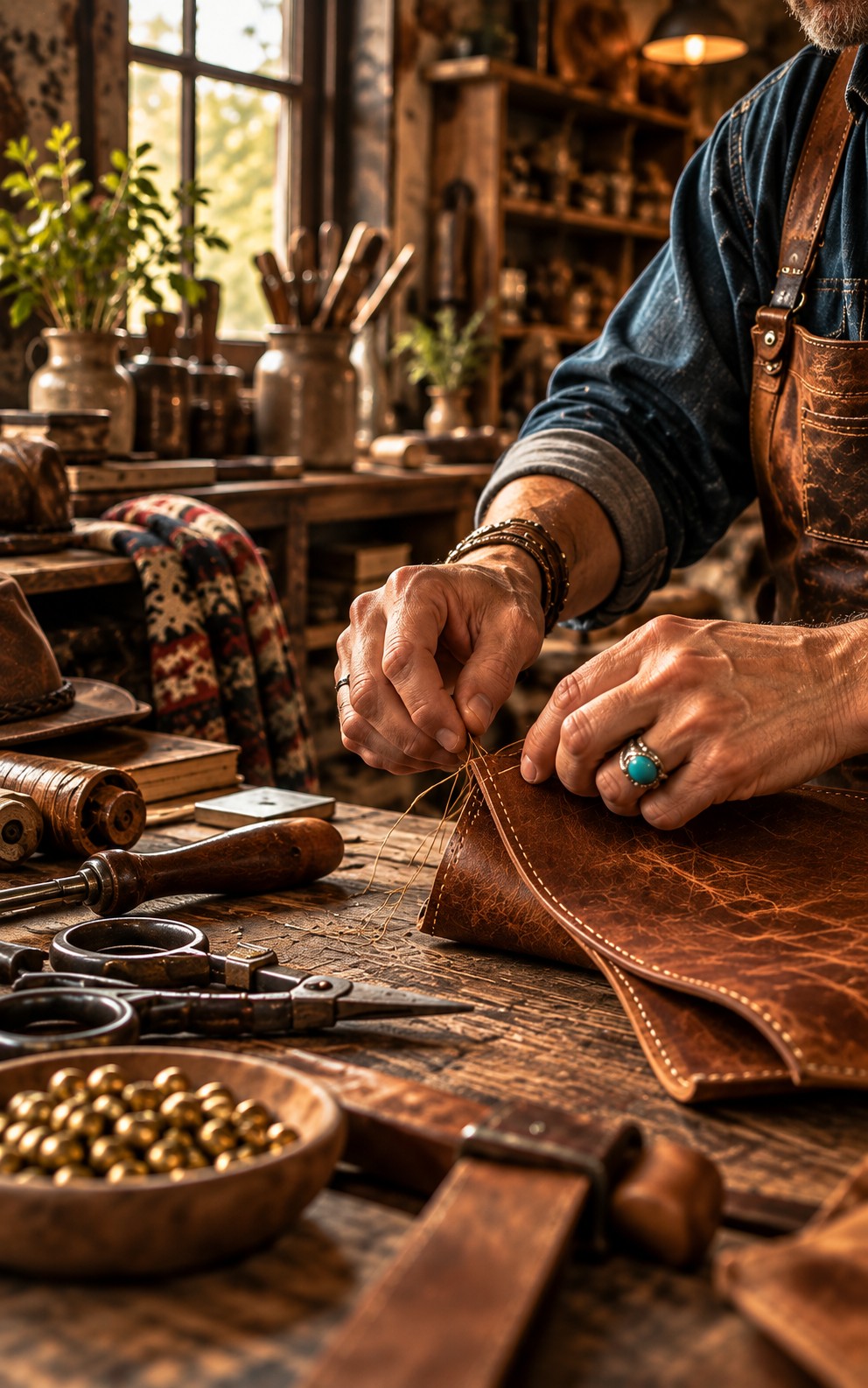
I have been making things for as long as I can remember, and there is something deeply satisfying about taking a material in your hands and changing it. Clay, paint, wood, fabric, paper, leather, metal, whatever the medium happens to be, there is a very particular feeling that comes from touching something, working with it, and slowly bringing an idea into physical form.
That process is never completely neutral because your hands leave evidence behind. The pressure you use, the way you hold a tool, the marks you make, the choices you change halfway through, and the places where you work instinctively all become part of the finished piece. Even when two people are using the same material, the same tools, and the same basic instructions, they will rarely create exactly the same object.
That is one of the things I love most about work made by hand.
What Makes a Handmade Object Different?
A handmade object is shaped by direct human involvement, and that involvement creates variation, individuality, and character that are difficult to reproduce through mass production.
The difference is not simply that a person made it rather than a machine. It is that the maker was present throughout the process, making choices along the way and responding to the material as the object developed.
A pot may be slightly uneven because of the way it was pulled on the wheel. A piece of furniture may carry tool marks from the person who shaped the wood. A hand-forged piece of metal may show subtle variations in texture and finish, while a painting holds the movement of the brush, the pressure of the hand, and the decisions made while it was being created.
Those details are not necessarily flaws. They are evidence of process, and they remind us that there was a person on the other side of the object.
The Material Pushes Back
One of the things I have always loved about making is that the material has a voice in the process too.
You may begin with a very clear idea of what you want to create, but the material often has its own limitations, strengths, and surprises. Wood has grain. Clay has moisture and memory. Paint moves differently depending on the surface and medium. Leather stretches and softens, while metal responds to heat, pressure, and force.
You can impose your will on a material only so far, and eventually you have to work with what it is giving you. That relationship between maker and material is what gives handmade work so much of its character, because the final object becomes the result of both intention and response.
Sometimes the most interesting thing about a piece is the way the maker solved a problem that emerged during the process.
Imperfection Is Often the Signature
We have spent a long time being taught that quality means uniformity: perfect edges, perfect symmetry, identical finishes, and no visible evidence of how something was made.
There is certainly skill in precision, and handmade work can be extraordinarily exact, but perfection and craftsmanship are not always the same thing. In fact, some of the things that make handmade objects most compelling are the small irregularities that reveal the hand behind them.
A slight variation in glaze, a subtle change in line, a tool mark left intentionally visible, a seam that shows how a piece was constructed, or a carved surface that is not completely uniform can all make an object feel more individual.
Those differences are not simply decorative. They are part of the story of how the object came into being.
Making Is a Form of Attention
For me, one of the most meaningful parts of creating something is the attention it requires.
When you are working with your hands, you have to be present in a way that is difficult to fake. You are watching how the material responds, making small adjustments, and deciding when to continue and when to stop. That kind of concentration can be incredibly grounding and, at times, almost meditative.
Time feels different when you are deeply involved in making something. Hours can pass without feeling like hours because your attention is completely absorbed in what is happening in front of you.
That is one of the reasons I have always believed making has value beyond the finished object itself. The process matters too.
The Object Carries the Process
When you pick up something made by hand, part of what you are responding to is often the process that created it.
You may not know the maker, how long the piece took, or exactly what decisions went into it, but you can often see evidence that someone was involved. A hand-thrown bowl may show the faint spiral of the wheel. A carved object may hold small variations where the tool moved through the material. A hand-stitched leather piece may show subtle differences in spacing and tension.
Those details give the object a kind of presence because they connect it to the person who made it.
And once the object begins being used, another layer is added. The maker's marks remain, but the owner's life begins to leave marks too, which is where handmade objects become especially interesting to me because they start carrying both stories at once.
Craftsmanship Is More Than Technique
When people talk about craftsmanship, they often focus on skill, and skill certainly matters, but craftsmanship is also about judgment.
It is knowing which material is appropriate for the job, understanding how something will age, and choosing a joinery method, finish, weight, proportion, or construction technique because it will help the object function well and last.
It is also knowing when not to overwork something.
The best makers understand that every choice becomes part of the final piece, which is why two objects that appear similar at first glance can feel completely different when you hold them. One may have been designed primarily to be produced quickly and efficiently, while the other may have been considered in terms of material, balance, use, and longevity.
You can often feel the difference before you can explain it.
Handmade Does Not Mean Primitive
There is sometimes a tendency to romanticize handmade work as though it has to be rustic, rough, or traditional, but it does not.
Handmade objects can be incredibly refined, modern, experimental, or technically sophisticated. The value is not in making something look old-fashioned; it is in the relationship between the maker and the object.
A contemporary ceramicist, furniture maker, leather worker, textile artist, or metalworker may be using completely modern forms and ideas, but the work can still carry the unmistakable presence of the hand.
That is what interests me. Not nostalgia for its own sake, but evidence of human involvement.
Why Objects Shaped by Hand Matter at Futurology
At Futurology, we are drawn to objects that reveal how they were made and, when possible, something about the person behind them.
That might mean an antique piece of furniture that still shows hand-cut joinery, a handmade leather bag, a piece of pottery, original art, a woven textile, a forged object, or something newly made by a craftsperson working today.
What connects them is not age or style. It is intention.
These are objects where the material mattered, the process mattered, and the person behind the work mattered. I think that is especially meaningful now, when so much of what surrounds us is designed to be produced quickly, replicated endlessly, and replaced without much thought.
There is something powerful about an object that reminds you someone actually made it.
The Hand Leaves Something Behind
I think this is ultimately why handmade things feel different to me.
When someone shapes an object by hand, they leave something of themselves behind in it, not in some grand or mystical way, but through the countless small decisions involved in making. Where to cut, how hard to press, when to stop, what to leave visible, what to correct, and what to accept all become part of the finished piece.
When we choose to live with objects like that, we are not simply choosing how something looks. We are choosing to live with evidence of another person's time, attention, judgment, and skill.
For me, that is one of the most meaningful things an object can carry.
Futurology
A Modern Mercantile | Curated for a Life Well Made.